

Member Journey Mapping for Gyms: A Practical Guide

Member journey mapping means drawing every step a person takes with your gym, from the first inquiry to renewal or cancellation, and marking where they feel confident, confused or ready to leave. The map only pays off when it is built from real data (check-ins, bookings, payments, survey replies) instead of staff opinion, and when it is kept alive in the system your team already uses. Fitness Flow is built for that: sales, scheduling, billing and a branded member app sit in one platform, so the journey you draw is the journey you can actually measure.
Getfitnessflow
getfitnessflow.com
See the Member Journey in One Place
Fitness Flow brings sales, scheduling, billing and a branded member app together, helping you track the experiences that shape retention.
TL;DR
- Split the journey into five stages: discovery, sign-up, onboarding, active engagement and retention. Add a sixth for members who leave and might return.
- For each stage, record what the member wants, where they touch your gym (people, place, app, billing), what the data shows and who owns fixing it.
- Build the map from observed behavior, not from a staff brainstorm. Attendance gaps, unanswered leads and failed payments tell you where it breaks.
- The first 90 days matter most. Track first-90-day churn separately from overall churn.
- Fix one moment at a time, then watch attendance and retention to see whether it worked.
Table of Contents
- What a member journey map is and why gyms need one
- The stages of a gym member journey
- How to build your member journey map, step by step
- What a good journey looks like in practice
- Onboarding: the stage that decides most outcomes
- The data that validates your map
- Turning the map into fixes
- Why the map works better inside one platform
- See your journey in one place
- FAQ
- Sources
What a member journey map is and why gyms need one
A journey map is a one-page picture of the member’s experience over time. Generic guides on customer journey mapping describe a visual of touchpoints across a customer’s relationship with a company. A gym version is more specific, because the product is a habit. Members do not just buy; they have to show up, repeatedly, for weeks.
That is why a gym map is less about a sales funnel and more about moments. Gym Membership Tips suggests finding the few moments that create confidence, confusion or cancellation and redesigning those first, rather than trying to polish everything at once. That is the right instinct for an owner with limited time: a map is a tool for choosing what to fix, not a poster for the break room.
You are the reader who benefits most if any of these sound familiar:
- New members join in January and are gone by April, and you cannot say exactly when they drifted.
- Leads message you and wait a day for a reply.
- Front desk, trainers and billing each handle part of the member’s experience, and nobody sees the whole.
- You run more than one location and the experience differs from site to site.
The stages of a gym member journey
Use stages that describe what the member is trying to do, not your internal departments. “Sales” and “billing” are your org chart. “Decide whether this gym fits me” and “get through my first week” are the member’s goals.
Here is a practical set for an independent gym or studio:
StageMember’s goalTypical touchpoints
Discovery
Find a gym that looks right
Website, social, referrals, reviews, inquiry form
Sign-up
Join without hassle
Tour or trial, contract, waiver, first payment
Onboarding
Know what to do and feel welcome
Welcome message, first visit, intro class, app download
Active engagement
Build a routine
Classes, bookings, trainers, community, challenges
Retention
Keep getting value
Check-ins, billing, renewals, surveys, offers
Exit and return
Leave cleanly or come back easily
Cancellation, exit survey, win-back messages
This five-phase structure (discovery, sign-up, onboarding, active engagement, retention) matches the framework Gym Membership Tips recommends. Fitness Facility Management describes a similar arc in four phases and adds two details worth copying: onboarding should run for at least 90 days, with check-ins, intro classes and staff introductions, and the exit stage should be handled with integrity, including exit surveys and re-engagement campaigns.
How to build your member journey map, step by step
You can do this in a spreadsheet. The goal is not a pretty graphic. It is a table that tells you where to act.
Step 1: Pick one member type and one question
Start with a single segment, for example “new members in their first 90 days” or “members on the unlimited plan.” Write the question the map must answer, such as “Why do new members stop coming in week five?” A map for everyone answers nothing.
This is where things go wrong first. Owners try to map every member at once and end up with a generic chart that fits any gym.
Step 2: List the stages and the member’s goal at each
Use the table above and adjust the names to match how your members talk. Write each goal in the member’s words: “I want to know where to start,” “I want to book a class without calling.”
Step 3: Add touchpoints, in person and digital
For each stage, list every place the member meets your gym: a person, a physical space, a policy or a system. Include the dull ones, like the payment receipt, the waiver, the booking confirmation and the cancellation page. Those are often where trust is lost.
Gym Membership Tips groups these into five working zones (pre-sale interactions, onboarding, in-gym daily experience, digital touchpoints and retention communications) and suggests scoring each from 1 to 5 on clarity, response speed, effort and consistency. It also summarizes what each member type needs: prospects want speed and clarity, new members want direction and confidence, active members want convenience and reliability, at-risk members want proof that someone noticed them, and lapsed members want a simple path back. Write those needs next to your touchpoints.
Step 4: Attach evidence to every stage
This step separates a useful map from a wish list. For each stage, write down what you can actually observe:
- Discovery and sign-up: how fast leads get a first reply, how many tours become members, where leads go quiet.
- Onboarding: whether the member booked a first class, completed an assessment, downloaded the app, met a trainer.
- Engagement: visits per week, class bookings, app use.
- Retention: failed payments, freezes, cancellation reasons, survey scores.
A staff workshop alone tends to produce the journey you hope exists. Timestamps, complaints and cancellations often tell a different story. If a stage has no evidence, mark it “assumed” so nobody mistakes it for fact.
Step 5: Mark friction and emotion
Friction is any avoidable effort, ambiguity or failure in a moment. A contract that takes 20 minutes to sign, a class that cannot be booked from the phone, a card decline with no explanation: each is friction. Note the emotion where members have actually told you how they feel, in a survey, a comment or a conversation, rather than guessing.
Both kinds of friction count. Gym Membership Tips argues that fixing feelings without fixing workflows only creates a short-lived bump, and suggests measuring time to resolution, member effort per task and the handoffs between sales, front desk, trainers and billing.
Step 6: Give every moment an owner
A moment owner is the person with the authority to change or recover that part of the experience. “Front desk” is too vague; “front desk lead” works. Moments with no owner do not get fixed.
Step 7: Score and prioritize
Rate each friction point on how often it happens, how severe it is and how much you can control it. Fix the frequent, severe, controllable ones first. Change one moment, then watch the numbers before changing the next, otherwise you will not know what worked.

What a good journey looks like in practice
Two real examples show what strong mapping and onboarding look like.
Onboarding as a designed sequence. Club Solutions Magazine describes 425 Fitness enrolling members in a member portal at sign-up (for billing, receipts and cancellation policies), pointing them to the club app as their entry point, and sending the club rules. Another club it profiles uses an onboarding checklist at the first visit, pairs new members with a trainer for complimentary sessions, reviews the app and class sign-up, and checks in by phone across the first 90 days, with incentives such as club cash for completing two trainer sessions.
The same article reports an IHRSA study finding that 87% of members who had a positive onboarding experience were still active after six months. Treat that as the reason the first 90 days deserve most of your attention.
Mapping from real member observation. Heart of the Customer documents how a YMCA used mobile ethnography: members recorded text, photos and videos before, during and after visits and rated areas from 1 to 5. The resulting maps showed what each persona felt at arrival, workouts, class sign-up and wellness consultations, with friction points and moments of truth marked. The useful lesson was about what not to fix. Members were irritated by limited pool access and crowded locker rooms at peak times, but they trusted the brand enough to tolerate it, so the Y put its effort into other initiatives more likely to build loyalty.
You do not need a research budget to copy the spirit of this. A three-question survey after the first visit and a note of what staff hear at the desk will give you a rough version.

Onboarding: the stage that decides most outcomes
If you only have time to map one stage in depth, map weeks one through twelve. Members who do not form a habit early rarely form one later. A short list of what to capture:
- Time to first visit. How many days pass between sign-up and the first workout?
- First-week bookings. Did the member book a class or session before leaving the building?
- App activation. Did they download and log in?
- Human contact. Did someone learn their goal and their name?
- Early confidence. Some new members feel nervous about training in front of others. Resources on gym anxiety and training anyway can help you think about how to make the first visits less intimidating, and a warm intro class is one of your best tools.
Our own guide to the 90-day retention playbook goes deeper on what to schedule in those first weeks, and the piece on member app engagement covers how to get new members using the app early.
The data that validates your map
A map is a hypothesis until the numbers agree with it. Use these signals.
Attendance and engagement
Behavior shows trouble before a cancellation form does. A report on how US operators keep members after the January rush, summarized by NewsBeep, says The Edge Fitness Clubs tracks check-in trends in the first 30 and 60 days, fitness assessment completion, app engagement, class use, NPS feedback and pending-cancel activity. It also cites Engage PRO data placing churn risk highest in weeks four to six, with a gap of seven to ten days between check-ins, falling class participation and missed onboarding messages among the strongest early warnings.
For your map, that means adding a “risk signal” row to the engagement stage: no visit in seven days, no class booked, app unopened. Our guide to attendance tracking shows how to turn those gaps into a simple routine.
Billing
Some members leave without deciding to. An expired card or declined payment is friction the member never chose. Put payments on your map as a touchpoint, and see how to stop hard declines and recover soft ones and set up dunning emails so a failed charge does not become a lost member.
Feedback
Surveys give you the emotion column. Crunch Fitness’s 2026 spotlight, published by SMG, reports the chain unified member surveys, cancellations and contact forms into one listening approach and raised survey engagement to an average of 51 responses per club per month. For a single gym the principle is the same: collect feedback in one place so patterns are visible. Read more on member surveys for at-risk members.
Three numbers to track monthly
- Monthly churn: cancellations divided by members at the start of the month.
- First-90-day churn: how many new members leave in their first three months. Keep it separate. If it is far higher than overall churn, onboarding is the problem, not price.
- Active share: the percentage of members who visited at least once in the last 14 days.
For definitions and benchmarks, see retention metrics every membership manager should track.
Turning the map into fixes
A finished map should produce a short list, not a long one. A sample:
StageFriction foundEvidenceFixOwner
Discovery
Leads wait a day for a reply
Inquiry timestamps
Automatic first reply, then a call
Sales lead
Onboarding
Half of new members never book a second class
Booking data
Book the second class before they leave the first
Head coach
Engagement
Members vanish after two quiet weeks
Check-in gaps
Personal message at day seven without a visit
Front desk lead
Retention
Cards decline, members lapse
Payment failures
Retry and reminder sequence
Billing manager
Exit
Cancellations arrive with no reason
Blank exit data
Short exit survey plus an easy cancellation flow
Manager
The cancellation flow guide covers how to keep that exit step compliant and give members a reason to stay, and win-back emails tied to attendance cover the return path.
Write the date next to every change and every change in definition, for example when you start counting “active” as 14 days instead of 30. A chart whose meaning quietly shifts gives false confidence.
Why the map works better inside one platform
The hardest part of journey mapping is not drawing. It is gathering evidence from five places: a lead tracker, a booking tool, a billing tool, an email tool and an app. Each holds one slice of the journey, and none shows the whole.
Fitness Flow is an all-in-one gym management platform covering sales and lead tracking, CRM, class scheduling and booking, recurring billing, a fully branded member app, analytics and automated retention workflows. When those pieces share one member record, a lead’s first reply, their first class, their app activity and a failed payment sit on one timeline. Our guide to retention automation shows which moments of the journey are worth automating first.
Our perspective
A journey map is only as good as the data behind it, and most gyms lose the data in the gaps between tools. The lead lives in one system, the booking in another, the payment in a third, and the member’s drift away is nobody’s job to notice.
We built Fitness Flow to remove those gaps. Sales, scheduling, billing, engagement and analytics share one platform, with a fully branded app that keeps members connected between visits through live classes and gamified features. Our gyms see a 27% average increase in member retention and save 12 hours a week on administrative work, because the map stops being a document and becomes the way the gym runs.
Our advice: draw the first version this week, on one page, for the first 90 days only. Then let the numbers correct it.
Louis
See your journey in one place
If you want the journey you just mapped to run inside a single system, Fitness Flow offers the Solo plan at $149 per month and the Studio plan at $349 per month, with a Multi-site plan for owners running several locations. Migration support and integrations with popular payment and marketing tools are part of how we help gyms move over.
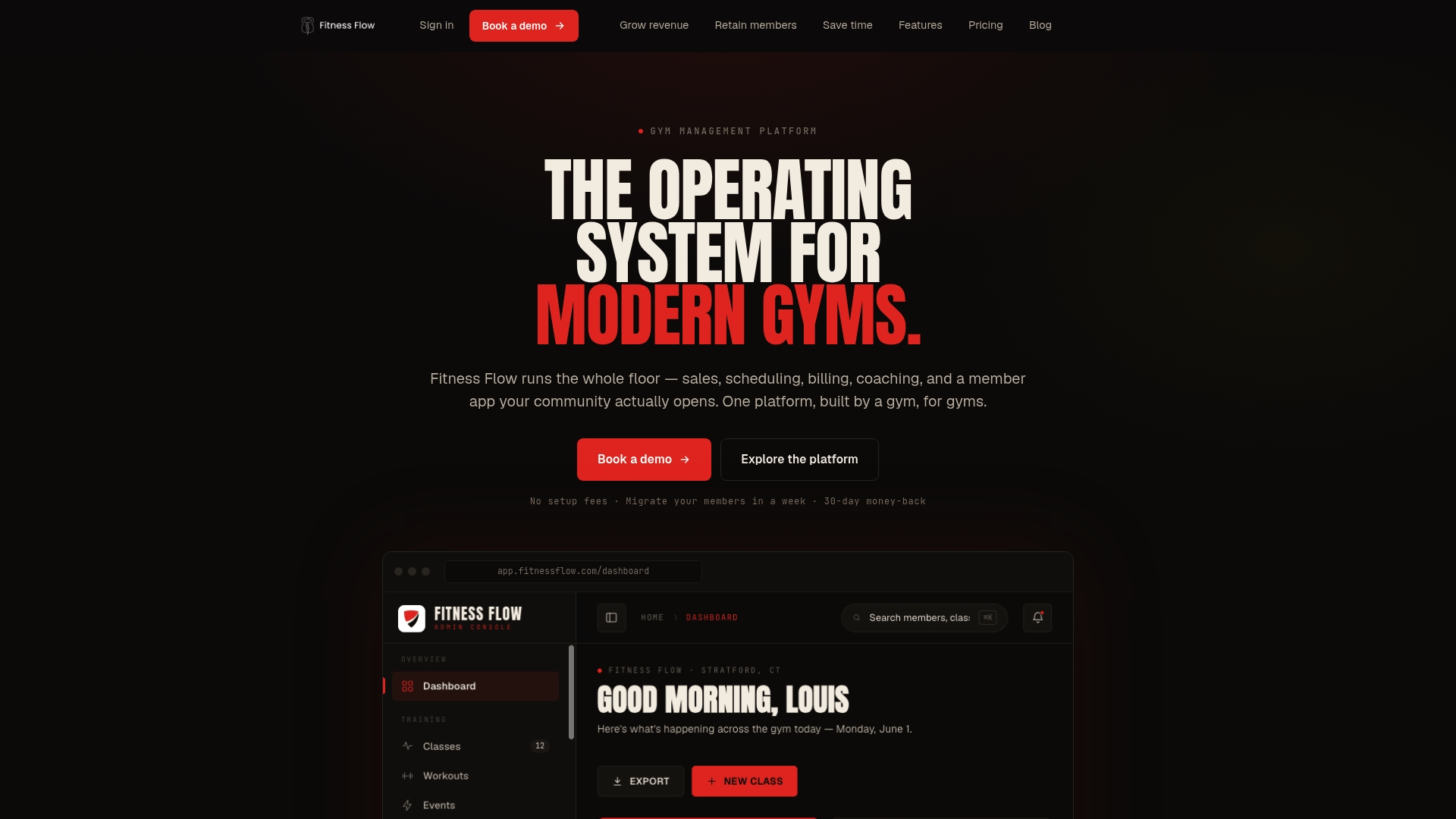
See the plans on the Fitness Flow site, or read how the platform works for gyms on our gym operations page.
FAQ
What does member journey mapping mean?
It means documenting each stage a member goes through with your gym, from first inquiry to renewal or exit, along with the touchpoints, friction and emotions at each one. The goal is to find the specific moments that cause confusion or cancellation so you can fix them in order of impact.
How many stages should a gym member journey map have?
Five or six is plenty: discovery, sign-up, onboarding, active engagement, retention, and exit or return. Some sources use four phases, others up to a dozen finer steps. Choose the level of detail your team will keep updating.
What data should I use to build the map?
Use lead response times, tour-to-join conversion, first-visit and first-class bookings, weekly attendance, app activity, payment failures, survey replies and cancellation reasons. Mark anything you cannot yet measure as assumed.
How often should I update the map?
Review it monthly alongside churn, first-90-day churn and active share, and redraw the affected stage whenever you change a process. Note the date of every change so you can compare results fairly.
Sources
- Customer Experience Optimization for Gyms (Gym Membership Tips)
- From Sign-Up to Loyalty: Gym Member Journey (Fitness Facility Management)
- Onboarding is the Key to Retention (Club Solutions Magazine)
- How the YMCA Used Journey Mapping to Boost Member Retention (Heart of the Customer)
- How Gyms Are Keeping Members After the January Rush (NewsBeep)
- Turning member feedback into a measurable growth engine (SMG)