

Gym CRM Setup in 1–3 Hours, Single Session Launch for Gym Owners

Yes, you can set up a working gym CRM and essential automations in one focused session. Choose your platform or book an onboarding call today, then expect a basic version live in roughly 1 to 3 hours, with a full member data migration taking anywhere from 1 to 7 days depending on your list size and integrations.
TL;DR:
- Most gyms can set up a functional CRM, including automation and member onboarding, within 1 to 3 hours in a single focused session; full data migration takes from 1 to 7 days.
- Building membership tiers, importing member data, and testing automations like welcome messages and failed payment workflows are critical steps before going live.
- Connecting essential integrations such as payment processing, website booking, and access control before launch minimizes post-migration cleanup.
- Prioritizing automations for retention and billing over detailed reporting during initial setup maximizes immediate value and reduces complexity.
- A full, polished system may require several days and more budget, especially for larger or multi-site gyms, but DIY setup is feasible for small gyms with fewer than 100 members.
Getfitnessflow
Simplify Your Gym CRM Setup
Fitness Flow brings sales, scheduling, billing, member engagement, and analytics together in one platform for modern gyms.
Table of Contents
- A single-session checklist to get your CRM live
- Full ordered setup: from business profile to testing and reporting
- Which integrations matter and how to migrate without disruption
- Realistic setup timelines and pricing expectations
- Practical TCPA and consent steps for CRM messaging
- Pre-launch and post-launch verification tasks
- Fitness Flow: how the platform maps to the setup steps
- What implementing gym CRMs teaches you about priorities
- Get your gym CRM running with Fitness Flow
- Sources
- FAQ
A single-session checklist to get your CRM live
You do not need a week to get a functional gym CRM running. Most owners can knock out the essentials in one sitting if they follow a set order and resist the urge to configure every feature before going live.
- Set up your business profile and staff accounts, including gym name, locations, time zone, and login access for managers or front desk staff.
- Connect a lead capture form with only the fields you actually need: name, phone, email, and how they heard about you.
- Create your membership products and connect a payment processor so you can charge for at least one plan.
- Build two or three automations: a welcome message, a trial follow-up, and a class reminder.
- Run one full member journey as a test, from signup to first payment to first class booking, then flip the switch to live.
That sequence matters because each step depends on the one before it. You cannot test automations without a member profile to trigger them, and you cannot test billing without a connected processor.
Pro Tip: Skip customizing report dashboards or advanced tagging on day one. Get leads flowing and payments processing first, then refine the rest once the CRM is live.
Industry reviews of gym management platforms consistently point to the same lesson: automation and consolidated billing matter more at launch than a perfectly organized backend. A roundup of the best gym management software found that retention-focused automations and combined billing and scheduling features deliver the most value to owners, which is exactly why the checklist above puts automations ahead of reporting.
Full ordered setup: from business profile to testing and reporting
A single-session checklist gets you live, but a proper setup takes more care if you want the system to run cleanly for months without cleanup work. Here is the fuller sequence, broken into the stages that actually determine whether your CRM holds up under real use.

Plans and products first
Build your membership tiers and trial rules before anything else touches the system. Decide whether trials are time-based (a 7-day pass) or class-based (three visits), because that rule shapes how your trial follow-up automation gets triggered later. Set pricing, contract length, and cancellation terms for each membership tier now. Retrofitting these rules after members are already in the system creates mismatched billing dates and confused staff.
Member and lead import
Keep imported fields to a minimum: name, phone, email, membership type, join date, and renewal date. A G2 industry evaluation recommends preserving membership status and renewal dates as their own structured fields rather than folding them into free-text notes, since automations and reporting both depend on clean, structured status data.
Sanitize your list before uploading:
- Remove duplicate entries and standardize phone number formatting.
- Strip out members who canceled more than a year ago unless you plan a win-back campaign.
- Flag anyone missing a valid email or phone number for manual follow-up instead of importing them blind.
Automations that do the heavy lifting
Four templates cover most of what a gym needs at launch:
- Welcome message, sent immediately after signup, confirming membership details and first steps.
- Trial follow-up, sent 24 to 48 hours before a trial expires, prompting conversion to a paid membership.
- Re-engagement, triggered after a member misses a set number of visits, nudging them back in.
- Dunning, triggered on a failed payment, requesting updated card details before the account lapses.
Industry guidance backs this priority order. The same G2 roundup singles out welcome flows, trial follow-ups, and failed-payment dunning as the highest-impact, lowest-effort automations a gym can build, delivering faster returns than lead storage alone.
Scheduling and classes
Set up class templates for your recurring schedule (spin, HIIT, yoga) with capacity limits and waitlist rules. Decide whether waitlisted members get auto-added when a spot opens or receive a manual notification. Configure your check-in flow, whether that is a kiosk, a staff scan, or a mobile app tap, since this is the data point most reporting dashboards rely on for attendance tracking.
Payments and billing
Connect your payment processor and confirm that tokenized card storage is active before you charge a single member; this keeps card data off your own servers and off your staff’s desks. Set your recurring billing cycle to match your membership terms (monthly, quarterly, or annual), and build a failed-payment workflow that retries the charge and notifies the member automatically rather than relying on staff to catch it manually.
Staff roles and permissions
Not everyone needs full access. Front desk staff typically need check-in and scheduling access only. Managers need billing and reporting access. Owners need everything, including staff account management. Limiting access reduces accidental changes to membership pricing or automation rules.
Pro Tip: Give new staff a read-only account for their first week. It lets them learn the system without risking a pricing change or an accidental automation edit.
Testing before go-live
Run these sample cases before you open the system to real members:
- A new lead fills out the form and receives the welcome automation within minutes.
- A trial member gets the follow-up message on schedule and converts to a paid plan.
- A payment fails intentionally (use a test card) and the dunning workflow fires correctly.
- A member books a class, gets waitlisted, then receives a notification when a spot opens.
- A staff account with limited permissions cannot access billing settings.
Catching a broken automation before launch is far less painful than fielding member complaints after the fact.
Which integrations matter and how to migrate without disruption
Not every integration deserves attention on day one. Four matter most: your payment processor, your website’s booking widget, your access control system if you use keycards or fobs, and your calendar or email and SMS provider. Get these four working before touching anything else.
Field mapping determines whether your migration goes smoothly or creates weeks of cleanup. When moving data from an old system, preserve these fields exactly:
- Membership status (active, frozen, canceled) as a discrete field, not a note.
- Renewal date, mapped to the same date format your new CRM expects.
- Payment tokens, if your processor supports token portability, so members do not need to re-enter card details.
- Contact preferences, including any existing marketing opt-in or opt-out status.
For the cutover itself, three approaches work depending on your risk tolerance. A parallel run keeps both systems active for a set window while you verify data matches. A date-based cutover picks a single day to switch entirely, which works well for smaller gyms with simpler billing. A member-segmented migration moves one location or membership tier at a time, useful for multi-site operations that cannot afford a full-system outage. A phased approach that runs old and new systems side-by-side for a subset of members can reduce revenue disruption during migration and gives you a chance to confirm billing behaves correctly before committing fully.
Pro Tip: Test every integration in a sandbox environment first. Run three real check-ins and two real payments through the sandbox before you trust it with your full member base.
Realistic setup timelines and pricing expectations
Budget your time and money before you commit to a platform, because the range between a bare-bones setup and a full migration is wide. A basic launch including business profile, lead form, one membership product, and a couple of automations typically takes a few hours. A full migration with historical member data, integrated billing, and access control can take 1 to 7 days depending on list size and how many systems you are connecting.
Gym management software pricing spans a wide range. Entry-level plans commonly start around $75 per month for small facilities, while franchise-level or multi-location operations often require custom pricing after a sales consultation.
A few factors shape whether you should budget for paid onboarding help:
- List size: importing under 200 members is usually manageable solo; larger lists benefit from migration support.
- Number of integrations: connecting payments, access control, and a website booking widget simultaneously raises the odds of a misconfiguration.
- Staff bandwidth: if no one on your team has time to run the testing checklist properly, a migration specialist earns back that time quickly.
- Multi-location complexity: syncing membership rules across locations is where most DIY setups run into trouble.
If your gym has fewer than 100 members and one location, DIY setup during a single session is realistic. Beyond that, the hours saved by paid onboarding usually outweigh the cost.
Practical TCPA and consent steps for CRM messaging
Text messaging is one of the highest-risk parts of a gym CRM setup if you skip consent rules. Courts have found that texts tied to a member’s existing contract can qualify as informational, while marketing texts generally require a separate, explicit opt-in. A Manatt legal analysis of a gym’s successful dismissal noted that the transactional context of a message matters under the TCPA, and a related Ninth Circuit ruling in Van Patten v. Vertical Fitness Group found that consent scope depends on how and why a phone number was originally provided, with any revocation needing to be clearly expressed.
Practical steps to reduce risk:
- Use a separate checkbox for SMS marketing consent, distinct from your general sign-up or waiver.
- Keep intake forms minimal and avoid bundling unrelated consents into one checkbox.
- Store a timestamped record of every consent, including the source (web form, in-person, paper waiver) and the exact language shown.
- Build an automated “STOP” workflow that immediately halts marketing texts and confirms the opt-out.
- Train front desk staff on the difference between a transactional reminder (class time changed) and a marketing message (a discount promo).
Treat consent records as part of the member file, not an afterthought.
Pre-launch and post-launch verification tasks
Before you announce the new system to members, confirm it holds up under the flows that matter most.
- Run five end-to-end tests: new lead signup, trial-to-paid conversion, class booking with waitlist, a failed payment triggering dunning, and a cancellation request.
- Verify recurring billing charges the correct amount on the correct date for at least three membership tiers.
- Confirm dunning messages actually send when a test payment fails, both by email and text if you use both.
- Check reporting accuracy by comparing active member counts and revenue totals against your old system or a manual count.
- Set a 7-day review to catch early issues like missed automations or mismatched billing dates, then a 30-day review to confirm retention and revenue numbers look stable.
Pro Tip: Assign one staff member to watch the dunning workflow for the first two billing cycles. Failed payments that slip through unnoticed are the most common source of member complaints post-launch.
Fitness Flow: how the platform maps to the setup steps
Fitness Flow covers the core stages of this setup process inside one platform rather than requiring separate tools for billing, scheduling, and member communication. The platform includes a fully branded member app, built-in automations for welcome, trial follow-up, and re-engagement flows, recurring billing with dunning workflows, and migration support for moving existing member data.
- A branded member app keeps members engaged between visits through live and on-demand classes and gamified features.
- Automated retention workflows handle welcome, trial, and re-engagement messaging without manual follow-up.
- Consolidated billing replaces the need for a separate payment processor subscription.
- Migration assistance helps preserve membership status and renewal dates during cutover.
Fitness Flow reports positive results in member retention and time saved on administrative tasks from its customer base.
What implementing gym CRMs teaches you about priorities
The gyms that get the most out of a CRM launch fast and imperfect rather than slow and polished. Start with the automation that saves you the most manual work today, usually the trial follow-up or the failed-payment dunning message, and build the rest afterward. Chasing a fully configured system before going live just delays the return you are trying to get.
The bigger mistake I see is over-collecting data at intake. A ten-field signup form kills conversions and gives you nothing useful; name, phone, email, and membership type is enough to run every automation that matters. Before any cutover, ask for a migration sandbox and run real payments through it. Billing errors caught after go-live cost far more time than a sandbox test ever will.
— Louis
Get your gym CRM running with Fitness Flow
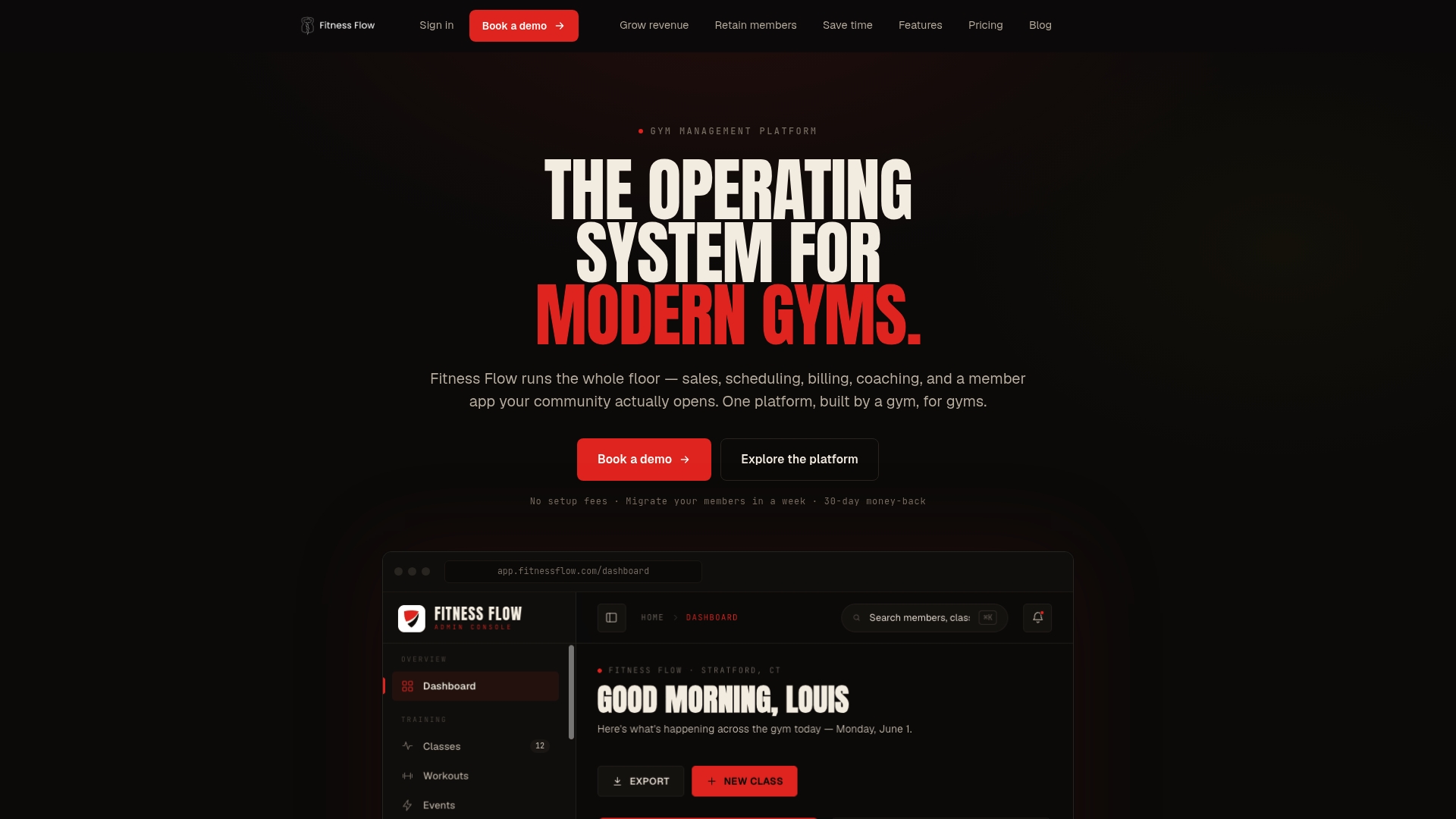
If the checklist above sounds like more setup than your week allows, Fitness Flow covers it in one platform instead of five. Member profiles, scheduling, automated follow-ups, recurring billing, and a branded member app all run from the same system, so there is no juggling separate logins or reconciling data between tools.
- Onboarding support to help import your member list and preserve renewal dates and payment tokens.
- Prebuilt automations for welcome, trial follow-up, and re-engagement messaging.
- A branded member app that keeps members connected between visits.
Plans run from Solo to Studio, with Multi-site pricing available on request. Book a demo or start a trial to see how quickly your gym can go live.
Sources
- Compare ABC Glofox and Gymdesk
- Gym wins dismissal after court finds texts informational - Manatt
- Bradley Van Patten v. Vertical Fitness Group, 847 F.3d 1037 (9th Cir. 2017)
- My evaluation of the 8 best gym management software (2026)
FAQ
What CRM do most gyms use?
There is no single CRM every gym uses. Independent gyms and studios typically choose from a handful of gym-specific platforms based on pricing, integrations, and whether the platform bundles billing and member engagement features in one system rather than requiring separate tools.
How do I set up a CRM?
Start by creating your business profile and staff accounts, then connect a lead capture form with minimal fields, set up membership products and a payment processor, and build two or three automations like a welcome message and trial follow-up. A basic version can go live in one focused session, typically 1 to 3 hours, while a full migration with historical data can take 1 to 7 days.
How much does Fitness Flow cost?
Fitness Flow offers a Solo plan at $149 per month and a Studio plan at $349 per month, with Multi-site pricing available on request through the Fitness Flow website.
What is the best POS system for gyms?
The right point-of-sale system depends on whether you need standalone retail checkout or billing that is already built into your gym management platform. Many gym owners prefer a system where recurring membership billing and point-of-sale transactions run through the same platform, since it avoids reconciling two separate sets of records.
How much does gym management software typically cost?
Entry-level gym management software plans commonly start around $75 per month for small facilities, while franchise-level or multi-location operations often need custom pricing after a sales consultation. Fitness Flow’s own plans run from $149 per month for Solo up to $349 per month for Studio, with Multi-site priced on request.