
Should Your Gym Run SMS Marketing? Here’s the Verdict

Yes. Gym SMS marketing works, and if you’re only going to build one automated channel this year, build this one first. Start with three moves: automate 24-hour and 2-hour class reminders, build a 7-day new-member onboarding text sequence, and set up a 14-day no-check-in win-back flow. Every promotional text requires documented opt-in consent under the Telephone Consumer Protection Act (TCPA), while transactional messages like appointment reminders are subject to lighter requirements. Get that distinction right before you send a single campaign.
- Reminders cut no-shows without staff phone calls
- Onboarding texts keep new members from ghosting in week two
- Win-back flows catch lapsing members before they cancel
Quick stat: 75% of consumers report making a purchase after receiving an SMS marketing message, a direct-response rate most gyms never see from email alone.
Key Takeaways
Gym SMS marketing succeeds when retention automations launch before promotional campaigns, and every message pairs documented consent with a clear, single call to action.
PointDetails
Compliance comes first
Collect documented opt-in consent and include STOP instructions before sending any promotional text.
Automate lifecycle triggers
Build 24-hour reminders, 7-day onboarding, and 14-day win-back flows off real PMS and billing events.
Track five core metrics
Monitor delivery rate, CTR, conversion rate, opt-out rate, and revenue per message from week one.
Protect deliverability
Complete 10DLC registration and avoid spam-trigger language to prevent carrier filtering.
Fitness Flow unifies the stack
Fitness Flow connects CRM, scheduling, billing, and two-way messaging so automation triggers run off real member activity.
Table of Contents
- Why Gym SMS Marketing Outperforms Other Channels
- High-Impact Use Cases and Ready-to-Copy Templates
- Setting Up SMS Marketing: A Step-by-Step Rollout
- Writing, Segmenting, and Testing Messages That Convert
- Connecting Your Systems and Tracking the Right Numbers
- What SMS Marketing Actually Costs and What It Returns
- Handling Replies: Why Two-Way Texting Can’t Be an Afterthought
- Fixing Deliverability and Carrier Filtering Problems
- Privacy and Data Security Beyond the Legal Minimum
- Fitness Flow’s Take: What Actually Moves the Needle
- How Fitness Flow Connects Your SMS Workflow to Everything Else
- Sources
- FAQ
Why Gym SMS Marketing Outperforms Other Channels
Text messages get opened. Email gets ignored, buried under promotions and receipts. That gap is the entire argument for gym SMS marketing: a member who won’t check their inbox for three days will read a text within minutes of it landing, according to Mailchimp’s fitness SMS guidance, which is exactly why time-sensitive messages belong on this channel and long-form content belongs elsewhere.
For gym operators specifically, that speed translates into concrete operational wins:
- Fewer no-shows on booked classes and PT sessions, since a same-day reminder catches people before they forget
- Faster lead-to-tour conversion, because a text reply beats a callback that goes to voicemail
- Recovered revenue from failed payments, caught same-day instead of surfacing on a monthly report
- Higher retention among at-risk members, since a check-in text costs nothing and reaches people apps and emails don’t
Keep the channel discipline simple: SMS handles anything urgent and actionable, email and your branded app handle policies, newsletters, and anything that needs more than two sentences.
High-Impact Use Cases and Ready-to-Copy Templates
The gyms getting real ROI from text marketing for gyms aren’t blasting promos. They’re running specific flows tied to specific moments in the member lifecycle: lead follow-up, trial onboarding, class and appointment reminders, waitlist alerts, payment dunning, renewal nudges, win-back sequences, referral prompts, and review requests.
Start with these six templates and adjust the tone to match your brand voice.
New member welcome (day 1): “Welcome to [Gym Name], [First Name]! Your first class is booked. Reply YES to confirm or call us with questions. Reply STOP to opt out.”
24-hour class reminder: “Hey [First Name], your [Class Name] class is tomorrow at [Time]. Reply C to cancel your spot.”
2-hour reminder: “[Class Name] starts at [Time] today. See you on the floor! Reply STOP to unsubscribe.”
Waitlist spot opened: “A spot opened in [Class Name] at [Time]. Reply YES within 15 minutes to claim it.”
Failed payment: “Hi [First Name], your payment didn’t go through. Update your card here: [link]. Questions? Just reply.”
14-day win-back: “We miss you at [Gym Name], [First Name]! Come back this week and grab a free session on us: [link].”
Sequence these around real triggers rather than a calendar. The welcome text fires the moment a membership agreement is signed. Reminders fire off your booking system, not a marketing calendar. The win-back flow fires off a no-check-in trigger in your PMS, not a guess about who’s drifting.
Pro Tip: Send the 2-hour reminder only for high no-show classes (early morning, popular instructors). Sending it for every class trains members to ignore it.
Setting Up SMS Marketing: A Step-by-Step Rollout
Picking the right platform matters more than picking the cheapest one. Run any option you’re considering against this checklist:
- Native integration with your scheduling and CRM/PMS system, not a manual export/import workflow
- Support for 10DLC registration (the carrier framework for business texting in the US)
- Two-way messaging, so members can reply and a staffer sees it, not just one-way blasts
- Prebuilt templates and automation triggers, not just a message composer
- Analytics on delivery, click-through, and opt-out rates
Opt-ins need to happen at every touchpoint: front desk sign-up sheets, online booking forms, a QR code on the check-in kiosk, and the trial-membership form. Each one needs explicit language, something like: “By providing your number, you agree to receive appointment reminders and promotional texts from [Gym Name]. Message and data rates may apply. Reply STOP to opt out, HELP for help.” That single sentence does the compliance work the FCC’s TCPA rules require for promotional messages.
Once opt-ins are flowing, map your first automation set: a 7-day onboarding sequence for new members, a 14-day no-check-in win-back trigger, a failed-payment dunning sequence, and a renewal reminder 30 days out. Pulling these triggers straight from PMS check-in and billing data, rather than running them as static campaigns, is what separates automated retention texting from a newsletter with a different name, per retention automation research.

Compliance checklist before you send anything: documented consent, clear opt-out instructions in every message, a working STOP keyword, and your 10DLC brand registration completed with your carrier or platform provider.
Writing, Segmenting, and Testing Messages That Convert
One idea per text. That’s the entire design philosophy for gym SMS marketing. A message asking someone to both renew their membership and refer a friend gets neither action taken. Keep it under 160 characters when possible, write like a human texting a friend, and always end with a single clear action.
Segment your list before you segment your messaging:
- Trial members vs. active members vs. at-risk (no check-in in 10+ days) vs. alumni
- Class-type preference (strength, group fitness, personal training)
- Payment status (current, failed, past due)
Timing matters as much as content. Send class reminders and workout nudges between 7 AM and 8 PM local time, and cap promotional sends at two to three per week per member. More than that, and opt-out rates climb fast.
Run A/B tests on one variable at a time: subject phrasing, CTA wording, or send time, never all three together. You need at least a few hundred sends per variant before the click-through and conversion numbers mean anything.
Do: personalize with first name and specific class or session details. Don’t: send generic “Check out our gym!” blasts with no context.
Pro Tip: A text referencing a member’s actual missed class (“We noticed you missed leg day Tuesday”) consistently beats a generic “come back” message, because it proves a human, or at least a system, is paying attention.
Connecting Your Systems and Tracking the Right Numbers
SMS marketing lives or dies on integration. Your CRM or membership platform needs to feed contact and behavior data into your texting tool, your scheduling and POS systems need to trigger reminders automatically, your billing provider needs to fire dunning sequences on failed charges, and your platform needs webhooks or two-way support so replies land somewhere a staffer actually sees them.
Track these metrics from week one:
- Delivery rate: percentage of texts that actually reach a phone, flags list quality and carrier filtering issues
- Click-through rate (CTR): how many recipients tap your link, the closest proxy to “read and engaged”
- Conversion rate: bookings, payment updates, or renewals directly tied to a text
- Opt-out rate: your early warning system for message fatigue or bad targeting
- Revenue per message: total attributed revenue divided by messages sent, your bottom-line ROI number
Use short links with UTM parameters on every campaign so your reports can separate “SMS-driven revenue” from “revenue that happened the same week.” A conversion tracking primer is worth reading if attribution setup is new to your team. Carrier-side deliverability also depends on following CTIA’s messaging guidelines, particularly around sender registration and message formatting.
What SMS Marketing Actually Costs and What It Returns
Pricing for fitness SMS campaigns usually stacks three components: a per-message or per-segment fee, a monthly platform subscription, and a one-time 10DLC registration fee through your carrier or provider. Setup and integration costs vary depending on how deep the CRM and scheduling connection needs to go.
Run ROI as a simple formula: (revenue recovered or generated from SMS) minus (platform and message costs), divided by cost. A single saved membership at $100/month covers months of platform fees for most boutique studios. Given that most consumers report purchasing after an SMS, the realistic benchmark for a well-run program is recovering its own cost within the first one to two billing cycles, mostly through failed-payment recovery and reduced no-shows.
Handling Replies: Why Two-Way Texting Can’t Be an Afterthought
A member who replies to your reminder text and gets silence learns fast not to bother replying again. That kills the single biggest advantage SMS has over email: it feels like a conversation, not a broadcast.
Route inbound replies to a shared inbox your front desk or a designated staffer checks throughout the day, not to a phone that sits in a drawer. Common replies fall into predictable buckets: cancellations, rescheduling requests, billing questions, and general inquiries. Set a response time target, ideally under 30 minutes during business hours, and train staff on a few standard responses for the recurring questions so nobody’s improvising at the front desk.
Keywords make two-way texting scale. Program automated responses for STOP (immediate opt-out, required by law), HELP (support contact info), and custom keywords like YES for confirmations or C for cancellations. Anything outside those keywords should route to a human, not a canned “we didn’t understand that” loop, which frustrates members fast.
A gym phone system built for two-way SMS and call routing can help consolidate voice and text replies into one place, so a member’s cancellation text and their follow-up call land with the same staffer instead of two disconnected systems. Whatever tool you use, the rule stays the same: if you enable replies, someone has to own answering them.
Fixing Deliverability and Carrier Filtering Problems
Messages that never arrive are the most common complaint gym owners raise about SMS marketing for gyms, and it’s almost always a registration or content issue, not a platform failure.
Unregistered 10DLC numbers get filtered or blocked by carriers, especially at volume. Messages containing spam-trigger words (“free,” “guarantee,” excessive punctuation, ALL CAPS) or too many links also get flagged by carrier filters, so keep templates clean and link count to one per message.
High opt-out rates or spam complaints can get a sending number throttled or blacklisted, which is why frequency caps and relevant segmentation aren’t just best practices, they’re deliverability insurance. If an entire campaign fails to send, check for carrier maintenance windows, exceeded rate limits (most platforms cap sends per second), and expired short links. Test every campaign with a small internal batch before a full send, catching a broken link or bad merge field on 5 phones beats finding out on 5,000.
Privacy and Data Security Beyond the Legal Minimum
TCPA compliance covers consent. It doesn’t cover what happens to a member’s phone number, birthday, or payment status once it’s sitting in your SMS platform’s database.
Store phone numbers and personal data only in systems with proper access controls, not in a shared spreadsheet three former employees still have a link to. Limit which staff roles can view member contact and billing data inside your platform, and audit that list periodically. If you operate in the European Union or serve EU residents, GDPR requirements around data minimization, the right to erasure, and explicit consent records apply on top of TCPA, and the two frameworks aren’t identical.
Set a data retention policy: how long do you keep the phone number and message history of a member who canceled two years ago? Most platforms let you automate deletion after a defined period, use it. And before signing with any SMS vendor, confirm where they store data and whether they’ve had a breach disclosure history. A vendor’s uptime guarantee means nothing if their data security posture is an afterthought.
Fitness Flow’s Take: What Actually Moves the Needle
The biggest mistake we see gyms make with SMS isn’t compliance, it’s sequencing. Operators launch a promo blast before they’ve automated the boring stuff: reminders, onboarding, and win-back. Promotional texts get the attention in sales pitches, but the retention flows are what pay for the platform.
Here’s a launch checklist to hand your manager: Week 1, register 10DLC and collect opt-in language at every intake point. Week 2, build the 24-hour reminder and new-member welcome flow. Week 3, add the 14-day no-check-in win-back trigger. Week 4, review delivery and opt-out rates before adding promotional campaigns. Target under 2% opt-outs and above 90% delivery before scaling volume.
How Fitness Flow Connects Your SMS Workflow to Everything Else
Running SMS as a separate tool from your CRM, scheduling, and billing means someone’s manually exporting lists and hoping the data stays in sync. That’s the gap Fitness Flow is built to close for independent and mid-size gyms.
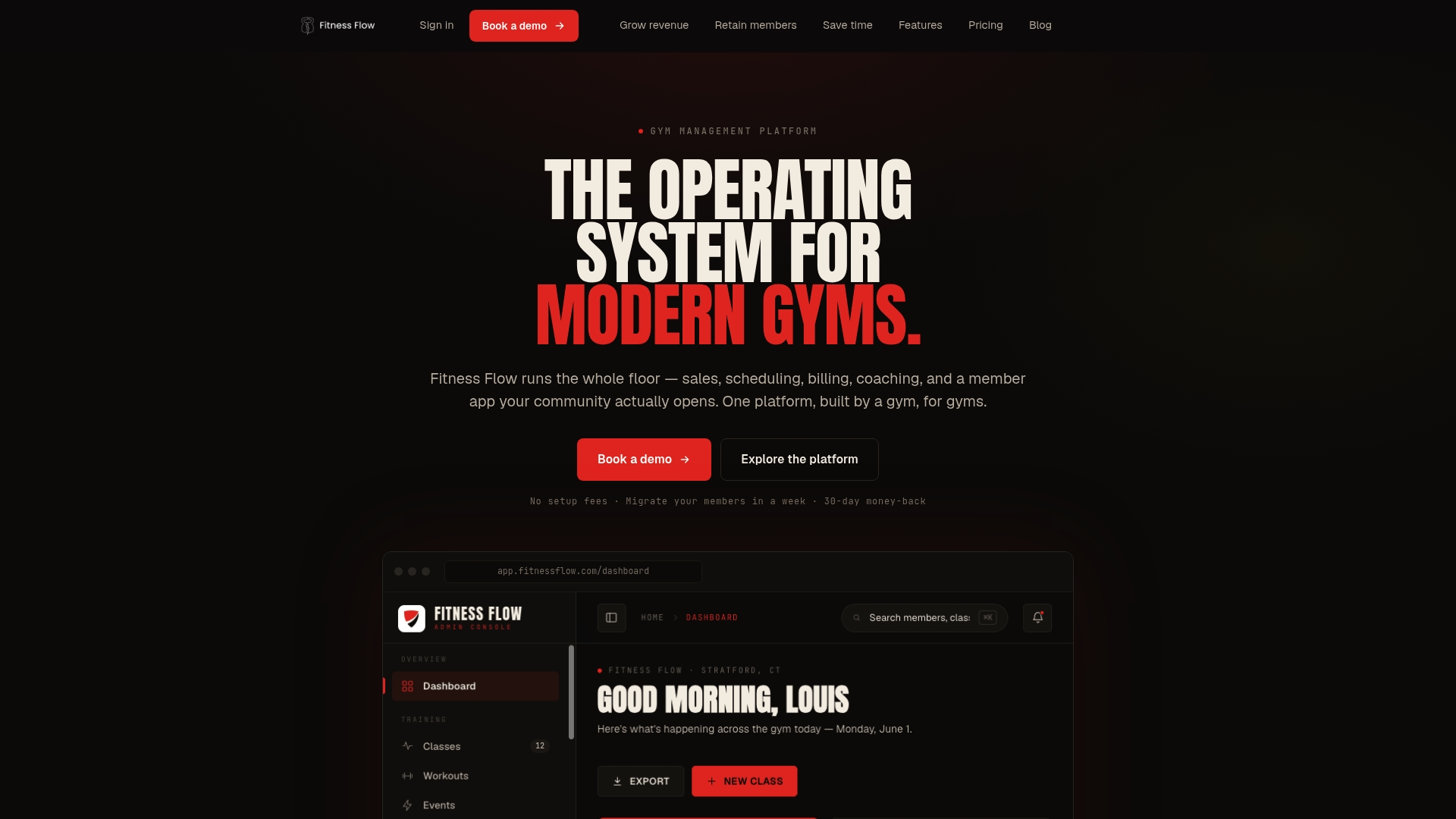
Fitness Flow ties your member database, class scheduling, billing, and a branded member app into one system, so the automation triggers covered in this guide, no-check-in flows, failed-payment dunning, renewal nudges, run directly off real member activity instead of a spreadsheet you update on Fridays. Lead capture and pipeline tracking feed your onboarding sequence automatically, and two-way messaging routes into the same dashboard your team already uses for scheduling and CRM.
If you’re piecing together three different tools to run the workflows in this guide, it’s worth seeing what one connected platform looks like. Explore Fitness Flow’s platform and book a demo to see how your specific setup, CRM, scheduling, billing, maps onto it.
Sources
- Telephone Consumer Protection Act rules (FCC)
- 75% of consumers made purchases as a result of SMS marketing (MarTech)
- Gym member retention automation ROI analysis 2026 (US Tech Automations)
- Messaging interoperability for SMS/MMS (CTIA)
FAQ
Does SMS marketing still work in 2026?
Yes. Text messages still get read within minutes by most recipients, and 75% of consumers report making a purchase after receiving an SMS marketing message.
Is SMS marketing worth it for a small gym?
For most independent gyms, yes, the platform and message costs are low relative to what a single recovered membership or reduced no-show rate returns, especially once automation handles the sending.
How much does gym SMS marketing cost?
Costs for gym SMS marketing vary by gym size, generally increasing with scale to cover platform fees, per-message costs, and 10DLC registration.
What are effective SMS marketing ideas for a gym?
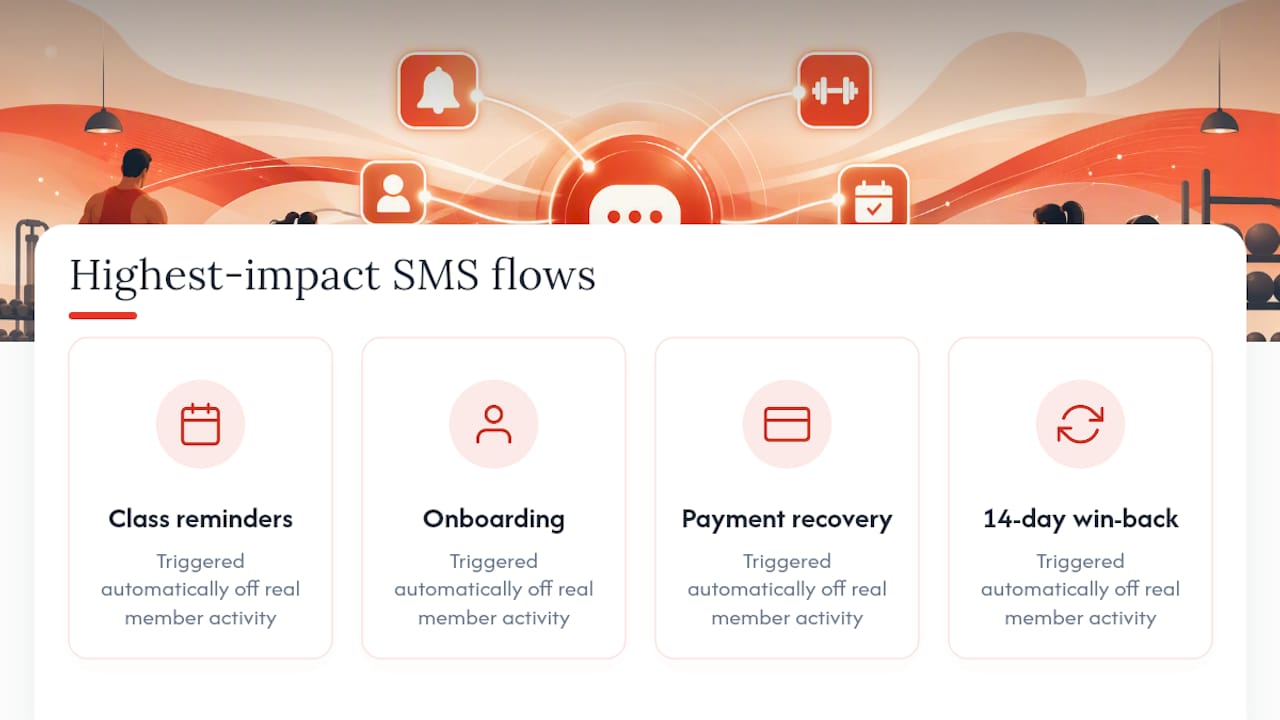
The highest-impact flows are class and appointment reminders, new-member onboarding sequences, failed-payment recovery texts, and 14-day no-check-in win-back campaigns, each triggered automatically off real member activity.
Does a gym need special registration to send SMS?
Yes, US carriers require 10DLC brand and campaign registration for business texting, and skipping it typically causes messages to get filtered or blocked.