

Win-Back Campaigns for Gyms: A Step-by-Step Playbook

A gym win-back campaign is a short, planned run of personal messages to members who stopped coming or who canceled. It works when you segment by how long they have been gone and why they left. Then send a small number of well-timed touches, make offers that match the situation, and count a member as won back only if they keep showing up. This guide walks through each step, from building the list to measuring the result.
Getfitnessflow
Keep Members Engaged Between Visits
Fitness Flow combines gym management tools with a branded member app, live classes and gamified features to support member engagement.
TL;DR
- Split lapsed people into groups (recently inactive, lapsed but still paying, cancelled) before you write a single message.
- Open with a personal, no-offer check-in, then move to a restart incentive and a time-limited offer over about three weeks.
- Keep real discounts for cancelled members. For members who are still paying, a free class or comeback week protects your pricing.
- Get consent right: CAN-SPAM rules for email, written consent for marketing texts.
- Count a win only when the member is still attending 90 days after returning.
Table of Contents
- Why win-back beats cold acquisition
- Step 1: Build the list from attendance data
- Step 2: Find out why they left
- Step 3: Segment so each message fits
- Step 4: Sequence the outreach
- Step 5: Choose offers that do not cheapen your membership
- When to reach out, and when to stop
- Stay on the right side of the rules
- Step 6: Measure what matters
- Our view: it starts before they leave
- Run win-back from one system
- FAQ
- Sources
Why win-back beats cold acquisition
A former member already knows your space, your coaches and your schedule. A stranger knows none of that. Operators interviewed by Club Solutions Magazine described cancellation as often paperwork that follows a broken habit, which is a useful way to think about it: the member did not stop believing in fitness, their routine slipped and the cancellation came afterward.
That changes how you write. You are not pitching a lead. You are following up with someone you have a relationship with. The same article reports that successful operators avoid discount-heavy recovery campaigns and prefer to reconnect people with specific programs or workshops they enjoyed.
There is also a plain cost argument. Every hour you spend on cold ads is an hour not spent on people whose names, visit history and favorite class times are already in your system.
Step 1: Build the list from attendance data
Start with your management system, not a spreadsheet from memory. Pull every member whose last check-in or class booking is more than a set number of days ago, and keep their visit history attached to the record.
You need three groups, and the definitions matter because they drive everything else. We use these working definitions in our own win-back guide:
GroupWorking definitionWhat it means
Recently inactive
7 to 14 days past their normal visit window
Habit is wobbling, member is still engaged
Lapsed
30 to 60 days, billing still active
Paying but gone, the biggest risk of a cancellation next
Cancelled
Membership formally ended, or repeated failed payments
Needs a true win-back, not a nudge
Measure “normal visit window” against each person’s own rhythm. Someone who trains five times a week and goes quiet for ten days is a bigger signal than a twice-a-month visitor who skips a month. Our guide to attendance tracking covers how to set those baselines.
Two cautions on failed payments. A member whose card declined is not necessarily someone who wanted to leave, so handle those through a separate billing sequence first (see our dunning email guide) and only move them to win-back if recovery fails.
Clean the list before you send
Remove people who moved away, who are on a medical hold, or who have asked not to be contacted. Nothing damages a win-back campaign faster than a message to someone who told you last month they were relocating, or who is recovering from surgery. A staff member should scan the list name by name. It takes an hour and saves complaints.
Step 2: Find out why they left
The best message is the one that speaks to the actual reason. If you do not have the reason, get it.
For cancelled members, add a short exit survey at the point of cancellation. Keep it to four questions:
- What is the main reason you are canceling?
- How often were you visiting before?
- What made it hard to come?
- What would need to change for you to consider coming back?
The fourth question is the one most gyms skip, and it is the one that writes your win-back message for you. For lapsed members who are still paying, a quick call or text from a coach works better than a form. If you want a wider survey program, see our guide to member surveys.
Store the answer as a field on the member record, not in a note. Once the reason is structured data, your system can branch on it: price, schedule, injury, boredom, moved.
Not every reason is worth chasing
A member who moved to another state made a real decision. Writing to them wastes effort and can feel tone-deaf. Bill Hughes of Xyzios makes the point that win-back is a segmentation problem, not a copywriting problem. Spend your effort on reasons you can actually change: schedule, price, a program that ended, a coach who left, a stalled routine.
Step 3: Segment so each message fits
Use four filters together:
- Lapse length. How long since their last visit.
- Prior frequency. A former three-times-a-week member is a different conversation from an occasional drop-in.
- Membership type. Monthly member, annual contract or class pack.
- Reachability. Do you have a valid phone number with text consent, an email, or both?
Then map reasons to messages:
Reason givenAngle for the message
Cost
A new, lower-commitment option or a clear value reminder
Lack of time
Shorter classes, off-peak slots, a flexible schedule
Boredom or plateau
A new program, a new coach, a challenge
Injury or life event
A gentle check-in with no sales push
Moved
Leave them alone, or a friendly note if they travel back
If you review your own cancellation data first, you will often find that two or three reasons account for most departures. Build those flows first.
Step 4: Sequence the outreach
Keep the campaign short. Four touches over about three weeks is enough for most gyms. More than that starts to feel like pursuit.
- Day 1: personal text or call, no offer. Reference something real: their usual Tuesday class, the coach they liked. Ask how they are doing.
- Around day 4 to 7: a restart incentive. A free class, a comeback week, or a free session with a coach.
- Around day 10 to 14: an email with substance. Show what is new: schedule changes, new programs, a member story. Email suits longer content.
- Around day 18 to 21: a time-limited offer. One clear deadline, one clear action.
A phone call from an owner or manager can outperform any automated step for long-term members. Tara Minh at Re-Work describes win-back for tenured members as relationship work rather than marketing. If you have members who trained with you for years, call them yourself.
For members with a more recent lapse, an automated text-then-email flow tied to attendance is easier to run. Our blog post on win-back emails tied to attendance shows how to trigger two or three emails from visit gaps.
Pick the channel deliberately
Text messages tend to get read faster than email, which is why the first touch is usually a text. But texting carries stricter legal requirements (see below), and not every member has opted in. Use email where you lack text consent, and read our take on whether SMS marketing is right for your gym before building a text-first plan.
Tone: invite, do not plead
Avoid guilt and desperation. “We miss you, please come back” lands badly. “We’d love to have you back” and a specific reason to return work better. Write the way a coach would speak at the front desk, short and warm, with the member’s name and one concrete detail.
A sample first text for a lapsed member:
Hi Maria, it’s Dana from the gym. I noticed we haven’t seen you at the 6 a.m. class in a few weeks. Everything okay? Happy to help with anything that got in the way.
No link, no offer, no deadline. The goal is a reply.
Step 5: Choose offers that do not cheapen your membership
Offers should match the member’s status. A practical rule:
- Lapsed but still paying: a free buddy class, a comeback week, a free coaching check-in. They are already paying you, so a discount just reduces revenue you already have.
- Cancelled: this is where a real incentive can make sense, such as a waived joining fee or a reduced first month.
- Cancelled for a specific program or event: tie the offer to that program, such as a workshop or a new session of the class they loved.
Some operators use a two-tier approach: a higher-value offer (a consultation plus a body scan and a small gift) for people who were serious members, and a low-commitment offer (one free class) for everyone else. Gym Launch describes this kind of tiered offer structure, and the logic carries over to a small studio: give more to the people who were more engaged, and make the entry step easy for the rest.
Be careful with blanket discounts. If every lapsed member gets 50% off, current members learn that the way to get a deal is to leave. Keep the incentive tied to a reason, a date and a limited audience.
When to reach out, and when to stop
Timing matters more than most gyms expect. Reach out too early and you are intrusive. Wait too long and the habit is gone.
As a working rule, treat roughly the first four months after someone’s last visit as your best window, and plan to work the freshest lapses first. After that, response typically falls off, so move older names into a lower-effort periodic email, not a heavy sequence. Treat this as a starting point and check it against your own reactivation data, since gyms differ.
On follow-ups, cap each person at four touches in a campaign and stop on any reply or opt-out. Then wait several months before a second campaign. A member who says “not now” should hear from you again, but not next week.
Stay on the right side of the rules
This part is not optional, and the penalties are real. Check with a qualified attorney for your situation, but these are the basics.
Email. Under CAN-SPAM, commercial emails generally must be identified clearly as ads, include a valid physical postal address, and explain how to opt out. Honor opt-outs promptly.
Text. Marketing texts sent with automated systems fall under the Telephone Consumer Protection Act. The FCC’s rules require prior express written consent for autodialed or prerecorded telemarketing calls to wireless numbers. In practice, that means you need documented permission to send promotional texts, and a former member’s old signup form may not be enough. Our list of SMS consent items every U.S. gym should keep covers what to record, and our post on two-way texting explains how to get consent before you send.
One detail that helps: an FCC document says a text confirming an opt-out request does not violate the TCPA as long as it carries no marketing or promotional content. So reply “You’re unsubscribed” and nothing else.
Where you do not have text consent, do not text. Use a call from a person or an email instead.

Step 6: Measure what matters
Track four numbers for every campaign:
- Entries into the lapsed segment each week, so you see the size of the problem.
- Win-back rate: the share of contacted members who return within 30 days of the first touch.
- Opt-out rate: a rising number tells you the cadence or tone is off.
- Revenue attributed to the campaign.
Then add the number that keeps you honest: how many of those returners are still attending 90 days later. A returned member who visits twice and vanishes is not a win, and a campaign that brings back many of them looks better than it is. Counting only members who are still booking classes at day 90 gives you the real picture, as Xyzios argues. Pair this with the metrics in our guide to retention metrics and the cohort approach in our cohort analysis playbook.
Re-engagement does not end at the first visit. The first 90 days after someone returns deserve the same attention you give new joiners, which is the subject of our 90-day retention playbook.
Our view: it starts before they leave
We build gym software, and what we see repeatedly is that win-back is the expensive end of a problem that starts earlier. By the time someone cancels, you are paying in staff time, discounts and goodwill to get back what a two-week gap in attendance could have flagged.
That is why we think of win-back as three layers, not one campaign. First, catch the gap while the member is still paying and a coach can say hello. Second, capture the reason at cancellation so the data is structured. Third, run a short, personal, consent-compliant sequence for those who left, and judge it by who is still training three months later.

The common failure is tooling. Attendance lives in one system, billing in another, texts in a third, and the app in a fourth. Nobody connects “missed three weeks” to “send a check-in” because the data never meets. A single platform that holds visits, billing, messaging and the member app makes that connection automatic. It is also why our customers report saving admin time, and our own published figures are a 27% average increase in member retention and 12 hours saved on admin per week.
Most of all, remember that the message matters less than the relationship behind it. A real person who remembers the member’s class is worth more than any template.
— Louis
Run win-back from one system
If your win-back process today means exporting a list, copying it into a mailing tool and hoping someone remembers to text, you are doing the work three times. Fitness Flow connects attendance, billing, messaging and a fully branded member app, so a lapse can trigger the right message automatically and the result shows up in your reports.
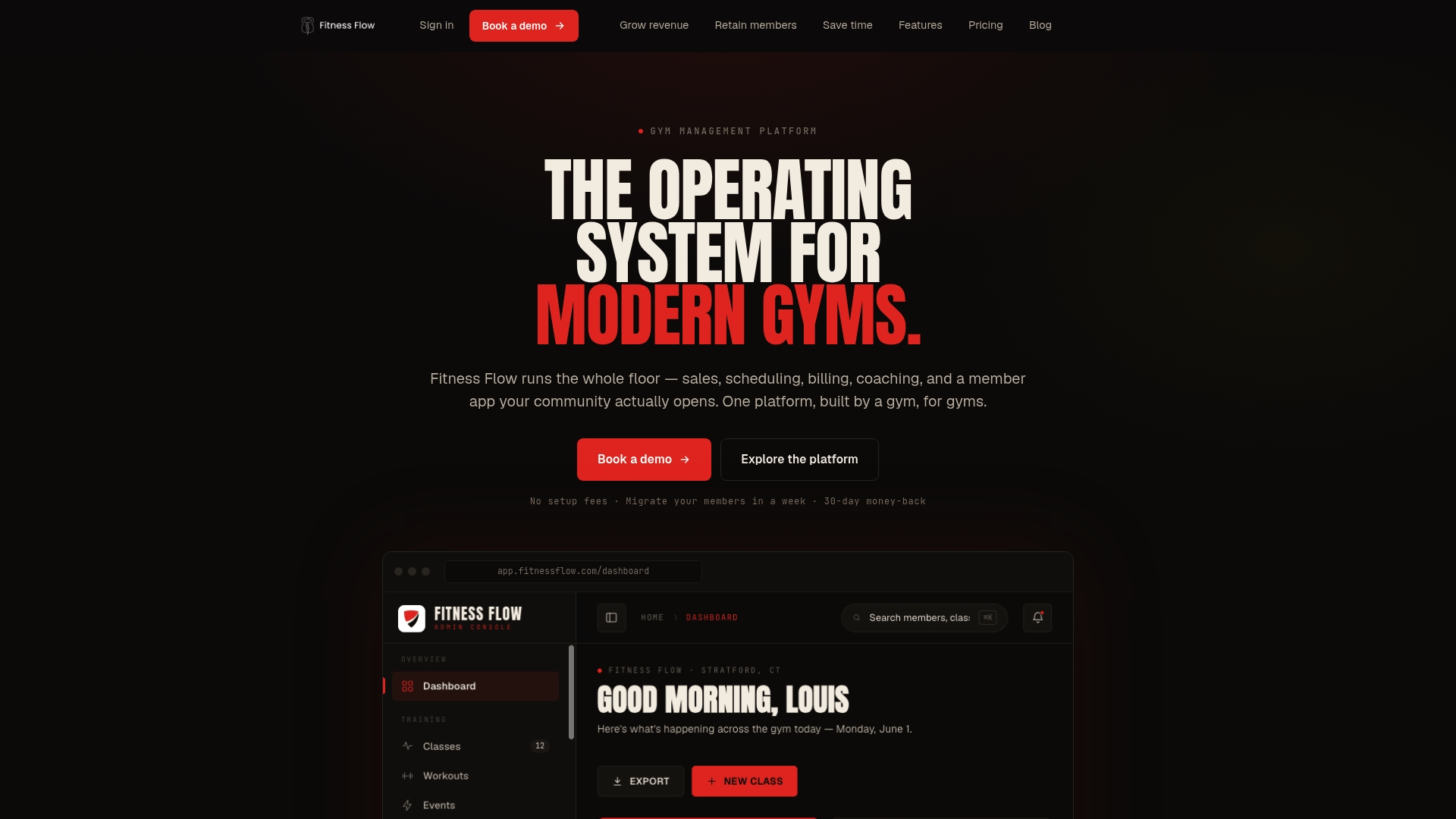
Plans start with Solo at $149 per month and Studio at $349 per month, and Multi-site is available for owners with several locations. See the plans and what each includes, or look at how the platform works for gyms.
FAQ
How long should I wait before sending a win-back message?
Start when attendance slips well beyond a member’s own normal rhythm, not after they cancel. For still-paying members, a personal check-in a couple of weeks past their usual pattern is reasonable. For cancelled members, begin soon after the cancellation while the habit is recent, and work the freshest names first.
Should I offer a discount to win members back?
Not as a first move. Begin with a personal check-in, then offer something that costs you little and shows the value of membership, like a free class or a comeback week. Save real discounts for people who have already cancelled, and tie them to a reason and a deadline.
Is texting former members legal?
Only with the right consent. Marketing texts sent with automated systems generally require prior express written consent under FCC rules, so a member who never agreed to texts should get a call or email instead. Keep records of consent and honor opt-outs immediately. Ask an attorney to review your forms.
How many messages should a win-back campaign include?
Four touches over about three weeks works for most gyms: a personal check-in, a restart offer, a content-rich email and a time-limited final offer. Stop the sequence as soon as the member replies or opts out.
How do I know the campaign worked?
Track how many contacted members return within 30 days, then check how many are still attending 90 days later. The second number is the one that shows whether you brought back real members or one-time visitors.
Sources
- Club Solutions Magazine: They Left. Now What? How Fitness Clubs are Winning Back Former Members
- Xyzios: How to Win Back Former Members at a Fitness Studio
- Gym Launch: How to Reactivate Cancelled Gym Members
- FTC: Candid answers to CAN-SPAM questions
- FCC: 2012 order implementing the TCPA
- FCC: What the Further Notice Would Do